


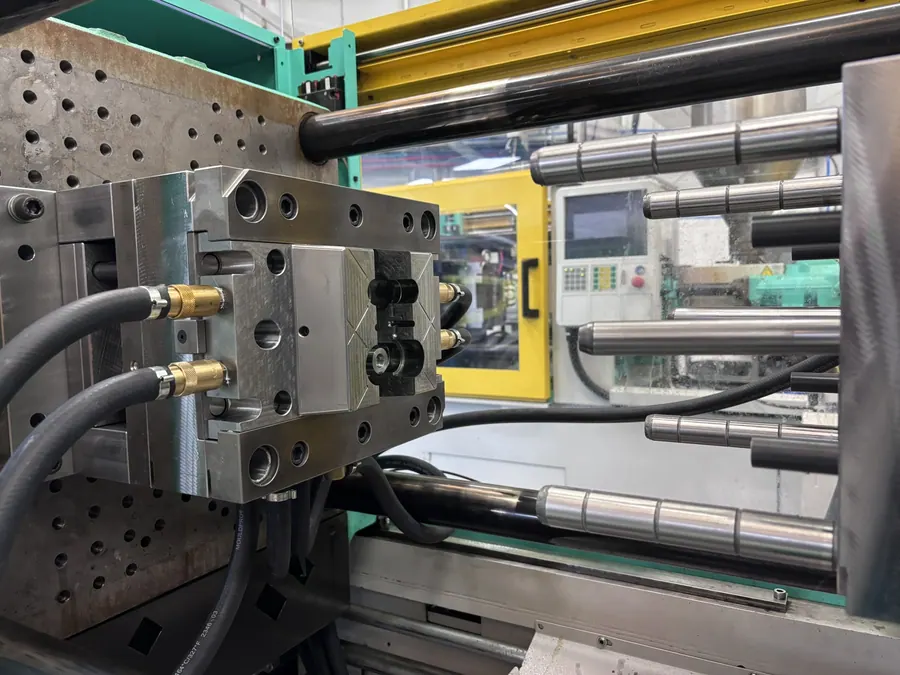
Whether you need to verify a design, test a component or conduct pre-production runs, prototyping is the step that lets you move forward with confidence. It is not just about creating a model, it is about refining the design and confirming it can be manufactured.
We supply insert sets or complete moulds. In special cases T1 samples can be ready in around 2 weeks.
Prototypes moulded in the production material
We make high-fidelity prototypes that mirror the final production parts as closely as possible. These are injection moulded components with the details, surface finishes and material properties of the final product.
- Test fit, form and function with parts that are virtually identical to the final product
- Steel moulds, so there is no compromise on part quality even at the prototype stage
- Tools typically guaranteed to 50,000 shots and depending on construction and part complexity considerably more
Steel or aluminium
We offer both. Which one suits depends on the part, the quantity and what the prototype has to prove.
The difference in material costs and machining times is not as significant as it used to be. With steel we can achieve finer details, better surface finishes in polish and texture and more parts from the same mould. If the production tool will be steel, it makes sense to validate prototype parts made the same way. We can also store your moulds for future requirements should you need further batches.
Where the part is simple, the quantity is small or the timescale is tight, aluminium does the job.
Additive manufacturing prototypes
Advances in additive manufacturing have changed the way prototypes are made. We use FDM in-house, and can arrange other processes where the application suits them:
- FDM, Fused Deposition Modelling. Functional prototypes from a continuous thermoplastic filament. Good for complex geometries and for producing parts quickly and cost-effectively.
- SLA, Stereolithography. A UV laser cures layers of resin, giving highly detailed parts with an excellent surface finish. Suited to visual models and parts needing high precision.
- SLS, Selective Laser Sintering. A laser sinters powdered material, creating strong, durable parts without support structures. Good for functional prototypes that need to behave like moulded parts.
Why prototyping matters
- Identify and resolve issues early. A prototype is a tangible representation of your design, which makes it far easier to spot problems with fit, form or function before they become costly in production.
- Validate materials and process. Test different materials, design features and manufacturing processes so the final product meets its specification.
- Move faster. Prototyping enables quicker iteration, so you reach production with more confidence.
Lead time
We give you a date when we quote. Not a headline figure, a date for your part, against what is already on the bench. We would rather quote a date we can hold than a fast one we cannot.
If you need parts in your hand sooner than a tool can be cut, we will print them in the meantime so the programme keeps moving.